.jpg)
European poultry farmers are turning to insects because soy has become a cost, compliance and supply-risk problem, not a nutrition story. Feed is nearly 70% of operating cost. Imported soy still sits in the middle of that line.
Geopolitical instability and climate regulation are making that reliance a liability. How to start a black soldier fly farm is the operator sequence if the protein is produced on site rather than bought as meal.
The market for soy has turned into a game of financial “Russian roulette.” In 2022, prices surged to €514 per ton, driven by a perfect storm of drought and global conflict. Even when prices stabilize, as they have recently around €350 per ton, the threat of sudden spikes remains. A single bad harvest in South America or a logistical strike can wipe out margins overnight.
To make matters worse, the regulatory landscape is shifting beneath farmers’ feet. The upcoming EU deforestation regulation (EU 2023/1115) draws a hard line in the sand: by the end of 2025, producers must prove their soy is “deforestation-free” with precise geolocation. The penalty for failure—fines up to 4% of annual turnover—turns compliance into a survival issue.
Reclaiming sovereignty
This is where the Black Soldier Fly offers an exit. Producing protein on-site bypasses the soy chain. Soy prices can swing by 40% in a year. In-house BSF cost variations in this post are around 5%.
| Comparison in this post | Soy | On-site BSF |
|---|---|---|
| 2022 price / protein cost | €514/t soy; later ~€350/t. Protein €0.45–€0.60/kg | Protein under €0.25/kg in efficient on-site rearing |
| Price swing | Up to 40% in a year | About 5% |
| EU 2023/1115 deforestation proof | Geolocation required by end of 2025. Fines up to 4% of turnover | Traceability starts and ends at the farm gate |
| Digestibility named here | ~78% for soy meal | Nearly 85% |
| 2024 Hy-Line trial (15,000 hens, 20% vegetable protein replaced) | Baseline | 5.3% more eggs, three extra weeks at peak, 9% thicker shells |
The economics are hard to ignore. Efficient on-site rearing can drive the cost of protein down to under €0.25/kg—significantly lower than the €0.45–€0.60/kg range seen for soy in recent years. More importantly, because the larvae are produced within the farm’s own ecosystem, they are immune to the new deforestation regulations. The traceability chain begins and ends at the farm gate.
Beyond Basic Nutrition
Perhaps the most surprising aspect of switching to insect protein is the biological impact on the flock. Soy is a standard ingredient, but BSF larvae act almost like a functional food. They offer a digestibility rate of nearly 85%, meaning birds need less feed to achieve the same growth compared to the ~78% digestibility of soy meal.
The health benefits go deeper. The larvae are rich in Lauric Acid (35-40 g/kg), a natural antimicrobial that helps fight off pathogens like Salmonella and Clostridium perfringens, reducing the need for veterinary interventions. They also contain Chitin, which boosts the immune system and improves feather quality. When birds are healthy, production improves.
Real-World Impact
Data from a 2024 trial with 15,000 Hy-Line laying hens illustrates what this looks like in practice. When 20% of the vegetable protein was replaced with BSF larvae, the results went beyond simple cost savings. The flock produced 5.3% more eggs over the year and maintained peak laying production for three extra weeks, even during the darker winter months.
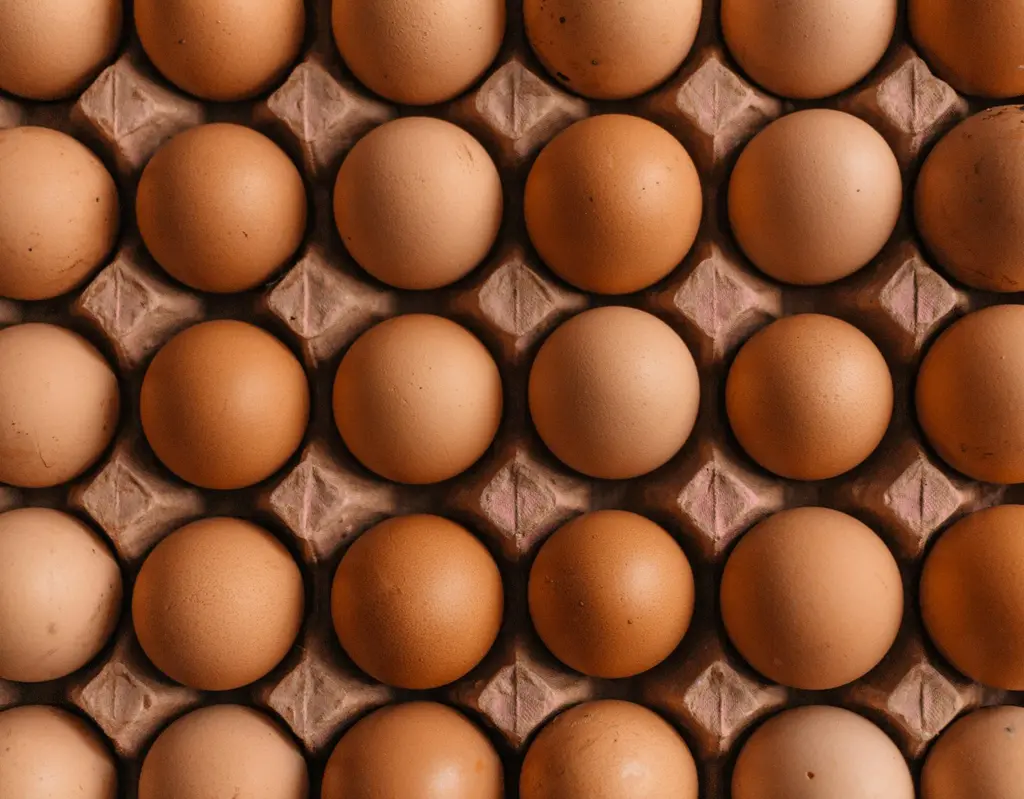
The quality of the product improved as well. Eggshells were 9% thicker, which meant fewer breakages and less waste. For a standard facility of 30,000 birds, these incremental gains add up to roughly 1.2 million additional eggs and an increase in annual revenue of nearly €50,000.
Ultimately, the shift to insect protein is about more than just being “green” or following trends. It represents a fundamental change in business logic: stopping the practice of renting profitability from volatile global markets and starting to generate value right at home.